

Smart Home Devices May Seem Expensive But They’re Actually Helping You Save
Smart-home devices close garage doors or secure your home, and if used properly, save energy and money. Americans spend $130 billion a year on wasted energy, and consumers can benefit by setting up smart-home devices using smartphones, control them remotely, on a schedule, connect them to a smart speaker, and perform independent actions.

Creator: AndreyPopov | Credit: Getty Images/iStockphoto
By ensuring better control over smart energy-saving devices, they save a lot. Here are tips for smart-home devices to reduce energy and water waste while saving money.
Smart plugs and lights

Creator: Westend61 | Credit: Getty Images/Westend61
If anyone leaves lights on, energy bills shoot up along with blood pressure. Smart lighting reduces bills by adding scheduling, remote control, and automation to everyday fixtures. Smart LED bulbs use 75 % less energy than incandescents, last 25 times longer with 40% additional savings by switching to dimming and can trigger other motion sensors, smart devices, or geo-fencing, for efficient operations. The Philips Hue line has smart-bulb kits both inside and outside homes. If clinging to bulbs and switches, a smart plug manages the scheduling and on/off functions for lamps and smaller appliances, and you can install money-conserving LED bulbs. The Wemo Mini smart plug costs under $30 per lamp, also controls holiday lights and can vacation-proof homes.
To conserve water

Creator: Daisy-Daisy | Credit: Getty Images/iStockphoto
According to EPA, daily household leaks waste 1 trillion gallons of water annually, equivalent to 1,500 Olympic-size swimming pools. Add a smart leak sensor monitor behind toilets, under sinks, around washing machines, and other leaky points. When the sensor detects a leak, a smartphone alert about the issue, ensures repairs before major problems occur. Smart water valves (Flo by Moen and Phyn Plus) installed on your water main, can alert you to leaks as small as a drippy faucet.
Kill vampire power
Electrical appliances and gadgets like TVs, computer speakers, and coffee-makers draw power even when not in use, a phenomenon called “vampire” energy. Experts estimate the annual power wastage is 50 large power plants’ electricity output. If powering several gadgets, try a smart power strip which tracks six devices individually. Just plug in your audio system, old plasma TV, space heater and schedule the strip to cut power off when devices are not in use. Individual cost savings aren’t dramatic, but add up with other energy savings.
A Nest Thermostat set to 76 degrees
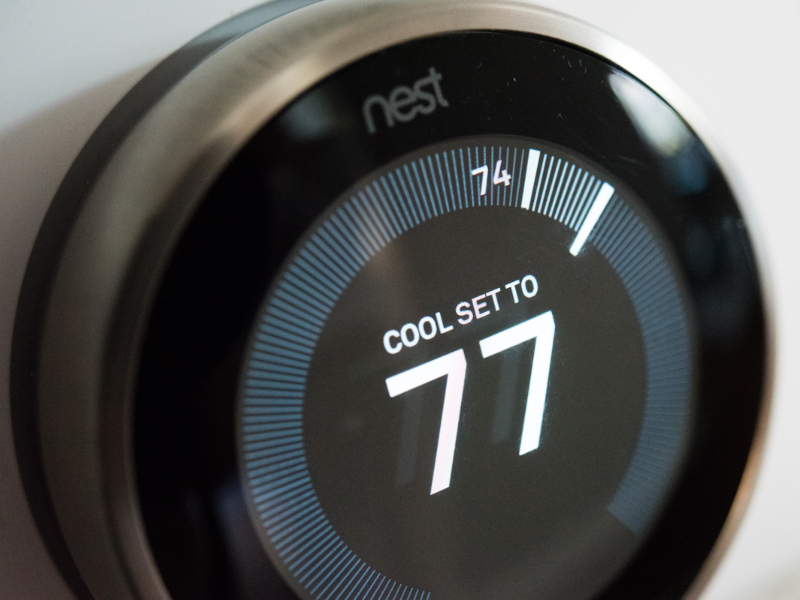
Creator: The Washington Post | Credit: The Washington Post via Getty Images | Copyright: 2016 The Washington Post
Smart fans (Big A** Fans, Hunter) include motion sensors to operate only when someone is in the room, besides integrating with a thermostat to maximize savings. A room fan with a smart plug is an affordable option. As much heat passes through windows, overheating in summer and heat loss in winter occurs. Shades reduce that, but smart shades (by Hunter Douglas, IKEA, and Lutron) set for specific times or on schedules, open and close to allow light (and energy) to pass though only when you desire.
Curb cooling and heating costs
Experts confirm electricity use by US households is most for fans and air conditioning, with households spending over $525 a year. A smart thermostat (Nest Thermostat E) optimizes your home’s heating and cooling, reducing electricity or fuel wastages by automatically adjusting temperatures to optimal levels based on habits, location, and cooling time for your home. A smart plug gives additional control to avoid wasting cool air in empty rooms.
More in Investments & Savings
-
`
 “Time is the Real Flex,” and ‘Luxury Wellness’ Means Slowing Down on Purpose, Says Jonathan Boynton
The idea of luxury has changed, and Jonathan Boynton-Lee is calling it out in plain terms. In a recent interview with...
April 25, 2026 -
`
 The Decline of Startup Funding. What’s Driving It?
The Regulation Crowdfunding market just hit a rough patch, and the numbers tell a clear story. In Q1 2026, total capital...
April 19, 2026 -
`
 Wealthy Elites are Going Big to Help “De-extinct” Wildlife
For most of the 20th century, conservation followed a familiar path. Governments led the charge, backed by treaties and public funding....
April 12, 2026 -
`
 Having No Savings Is Actually More Dangerous Than Carrying Debt, Here’s Why
Most people assume debt is the worst financial position to be in. That belief feels logical because debt comes with interest,...
April 5, 2026 -
`
 5 Practical Ways to Verify GoFundMe Legitimacy
Online fundraisers help people during medical emergencies, disasters, and personal crises. Millions of donors give money every year through GoFundMe because...
March 25, 2026 -
`
 Indian Tycoon Nirmal Jain Places His Biggest Bet on the Country’s Wealth Management Boom
India’s wealth market is heating up, and billionaire investor Nirmal Jain wants a bigger share of it. The founder of IIFL...
March 19, 2026 -
`
 Alphabet Secures $20 Billion in Debt With Rare 100-Year Bond to Fund AI Infrastructure
Alphabet just made a bold financial move that caught the attention of Wall Street and the tech industry. Google’s parent company...
March 11, 2026 -
`
 London Designers Embrace Everyday Luxury and Lifestyle
Design coming out of London has started to feel more grounded lately. Rather than chasing dreamy concepts, many creatives are focusing...
March 6, 2026 -
`
 Japanese Manufacturers Crowdfund a Hopping Robot to Explore the Moon
Japanese space exploration is getting a boost from an unexpected place. It is not coming from a giant aerospace firm or...
February 26, 2026
More From Refinance Gold
-
 This Rare, Two-Home Oceanfront Estate in Maui Hits the Market for $45 Million
Finding a private oceanfront home on Maui already takes serious money and patience. Finding two neighboring homes that form one sprawling...
Luxury & Life StyleSeptember 12, 2026 -
 Why Genki’s Crowdfunded Genki Manta Is Its “Most Ambitious Product” Ever
Genki is taking a much bigger swing at gaming hardware with the Genki Manta, a feature-packed pro controller now seeking funding...
Crowd FundingSeptember 4, 2026 -
 How ‘Revenge Saving’ Is Replacing Revenge Spending Among Americans
For a while, spending felt like a reward. After pandemic restrictions eased, Americans booked trips, upgraded wardrobes, ate out more often,...
Top Bank AccountsAugust 27, 2026 -
 38-YO Investor Lost $60,000 in the Stock Market Wipeout and Is Now Turning to Real Estate for Safety
Watching an investment portfolio fall is uncomfortable. But watching $60,000 disappear within weeks can change how someone thinks about risk altogether....
Investments & SavingsAugust 21, 2026 -
 The “Hidden Millionaires” Investment Strategies Everyone Can Follow
Some millionaires look surprisingly ordinary. They drive practical cars, live in comfortable homes, avoid flashy purchases, and rarely advertise how much...
Luxury & Life StyleAugust 15, 2026
You must be logged in to post a comment Login